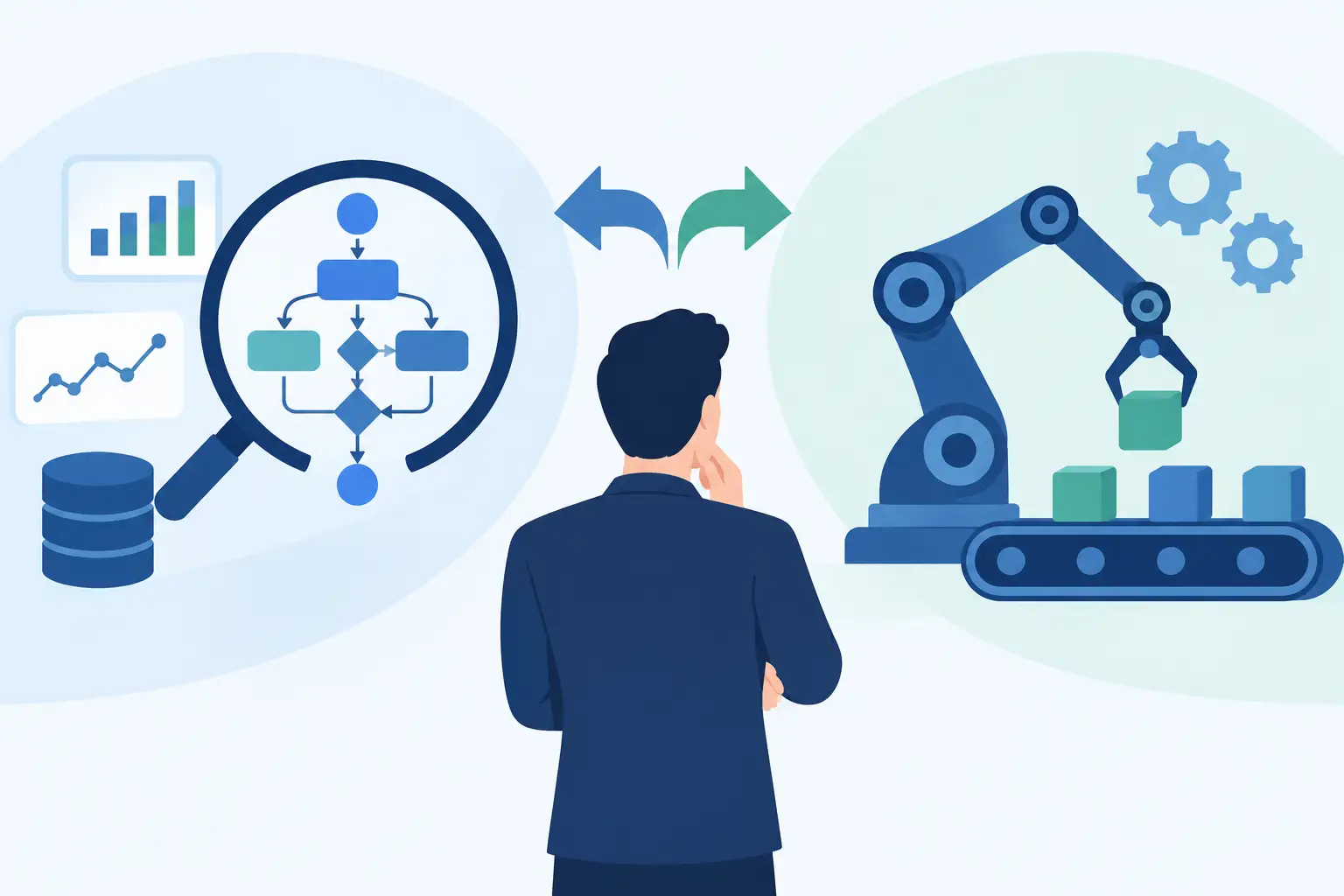
A finance team can automate invoice processing and still spend hours every week resolving exceptions, chasing missing purchase orders, and correcting coding errors. The issue is rarely that the automation platform failed. More often, the underlying workflow was never fully understood. That is the central distinction in process mining vs automation: one exposes how work actually moves through the business, while the other executes defined work with less manual effort.
For enterprise leaders, this is not a technology debate. It is a sequencing decision that affects ROI, governance, employee adoption, and the long-term cost of operating an automation landscape. Automating a fragmented process can make a poor process run faster. Process mining helps organizations determine what should be simplified, standardized, or removed before automation is introduced.
What Process Mining Actually Does
Process mining uses event data from enterprise systems such as ERP, CRM, ticketing, procurement, and workflow platforms to reconstruct the path that transactions take. Rather than relying only on workshops, policy documents, or interviews, it shows the process as it is performed at scale.
For example, an order-to-cash process may be designed to follow a standard sequence: create order, ship goods, issue invoice, receive payment. Process mining can reveal that a large share of orders takes a different route because of incomplete master data, manual credit checks, pricing overrides, or repeated approval loops. It can quantify how often those deviations occur, where delays accumulate, and which business units experience the greatest impact.
This matters because enterprise process problems are often hidden in variation. A team may know that month-end close is slow, but not know whether the delay comes from late journal entries, inconsistent approval thresholds, disconnected source systems, or rework caused by data quality issues. Process mining turns that uncertainty into evidence.
Process Mining vs Automation: The Core Difference
Process mining is a diagnostic and improvement capability. Automation is an execution capability. They are complementary, but they solve different problems.
| Area | Process mining | Automation | | — | — | — | | Primary purpose | Reveal process flows, bottlenecks, and variation | Perform repetitive, rules-based, or AI-assisted work | | Core input | System event logs and transaction data | Defined business rules, workflows, and triggers | | Main output | Process insights, compliance findings, and improvement priorities | Faster execution, fewer manual touches, and more consistent delivery | | Main risk when used alone | Analysis without action | Scaling inefficient or unstable processes |
Automation can include workflow orchestration, robotic process automation, document processing, integration, AI agents, and decision support. Its value is real when work is high-volume, repeatable, and governed by clear rules. But automation does not inherently determine whether the process itself is necessary, well designed, or supported by reliable data.
Process mining does not replace process ownership or operational expertise either. It shows what happened in the system, but leaders still need to interpret the findings, decide the target operating model, and execute changes across people, policy, data, and technology.
Why Automation-First Programs Often Stall
Many automation initiatives begin with a visible pain point: a team is overloaded, backlogs are growing, or manual work is creating errors. The urgency is understandable. Yet when teams move directly from pain point to bot build, they can overlook the conditions required for scale.
A bot designed around a local workaround may depend on unstable spreadsheets, inconsistent naming conventions, undocumented approval logic, or data fields that are frequently incomplete. The automation may work in a pilot, then require constant intervention as volumes grow or upstream processes change. What appeared to be a technology problem becomes a maintenance problem.
There is also a governance cost. When different departments automate independently, organizations can end up with duplicated logic, conflicting business rules, limited monitoring, and a collection of tools that IT and operations must support separately. The result is automation that delivers isolated productivity gains but does not improve end-to-end performance.
This does not mean every automation project requires a lengthy diagnostic phase. A stable, low-risk task with clear inputs and established rules can be automated quickly. The key is proportionality. The more complex, cross-functional, high-volume, or business-critical the workflow, the more valuable process evidence becomes before design decisions are made.
The Right Sequence: Evidence, Redesign, Automation
The strongest transformation programs connect process improvement, data management, and automation in a deliberate sequence. This creates a cleaner foundation for implementation and a clearer case for investment.
1. Start with a measurable business outcome
Define the operational result before selecting a tool. The objective might be reducing invoice cycle time, increasing first-pass yield, shortening customer onboarding, improving on-time delivery, or reducing the cost to serve. A clear outcome prevents teams from measuring success only by the number of bots deployed.
Baseline the current performance using metrics that matter to the business: throughput, lead time, exception rate, rework, compliance deviations, manual effort, and working capital impact. This establishes where improvement is needed and how benefits will be validated.
2. Use process data to identify the real constraint
Process mining can expose the points where transactions wait, loop, or leave the intended path. It can also identify the causes of variation across regions, plants, customer segments, or teams.
The goal is not to create a more detailed process map for its own sake. It is to find the few constraints that materially affect cost, service, risk, or capacity. In a procurement process, that may mean reducing non-standard purchase requests. In customer service, it may mean improving knowledge access so cases do not move between multiple queues. In finance, it may mean addressing master data defects that create recurring invoice exceptions.
3. Redesign the workflow and data foundation
Before automating, remove unnecessary approvals, clarify handoffs, standardize rules, and address data gaps. If several systems hold conflicting customer or supplier information, integration and data governance may create more value than automating the reconciliation workarounds.
This stage often requires difficult choices. Standardization can reduce local flexibility, and centralizing rules can require changes in ownership. However, those decisions are what make automation maintainable. A simplified process with reliable data has fewer exception paths, clearer controls, and a lower support burden.
4. Automate the work that remains
Once the target process is defined, automation can be applied with purpose. Workflow technology can route work and approvals. Integration can remove manual rekeying between systems. Intelligent document processing can extract and validate information. AI can classify requests, generate draft responses, or support human decisions within defined guardrails.
Not every step should be automated. High-value exceptions, ambiguous cases, and decisions with material legal, financial, or customer impact may require human review. The objective is not zero human involvement. It is to place human expertise where judgment creates value and remove manual effort where it does not.
5. Monitor performance after go-live
Automation is not the finish line. Processes change as volumes, policies, systems, and customer expectations change. Ongoing monitoring should track both technical health and business performance: completion rates, exception volumes, processing time, control compliance, and realized capacity savings.
This is where process mining can continue to provide value. It can verify whether the redesigned process is being followed, identify new bottlenecks, and show whether automation is delivering the intended outcome across the enterprise rather than in a single team.
When Automation Can Come First
There are practical exceptions to the preferred sequence. A team may have a stable, well-documented task that is fully rules-based and presents an immediate capacity issue. Examples include creating standard reports, transferring data between established systems, or sending routine status notifications. In these cases, a focused automation can deliver value quickly without a broad process mining initiative.
The decision changes when the task sits inside a larger process with frequent exceptions or multiple stakeholders. Automating customer onboarding, claims management, production planning, or financial close without understanding variations can shift the bottleneck rather than remove it. The right question is not, “Can this be automated?” It is, “What must be true for this automation to perform reliably at scale?”
Build an Operating Model, Not a Collection of Bots
The most effective enterprises treat process mining and automation as parts of one operational improvement system. Process owners define outcomes and controls. Data and architecture teams ensure reliable inputs. Technology teams implement integrations, workflows, and AI capabilities. Operations teams validate that the new design works under real conditions.
This integrated model avoids the common divide between business-led improvement projects and IT-led automation delivery. It also creates a more credible investment case because leaders can connect process changes to measurable results: fewer exceptions, faster cycle times, improved service levels, reduced manual effort, and better operational visibility.
For organizations with complex workflows, the next useful step is rarely another isolated automation idea. It is choosing one high-impact process, establishing a fact base from its data, and redesigning the work around the result the business needs to achieve. That is how automation becomes a scalable operating capability rather than a short-lived productivity fix.