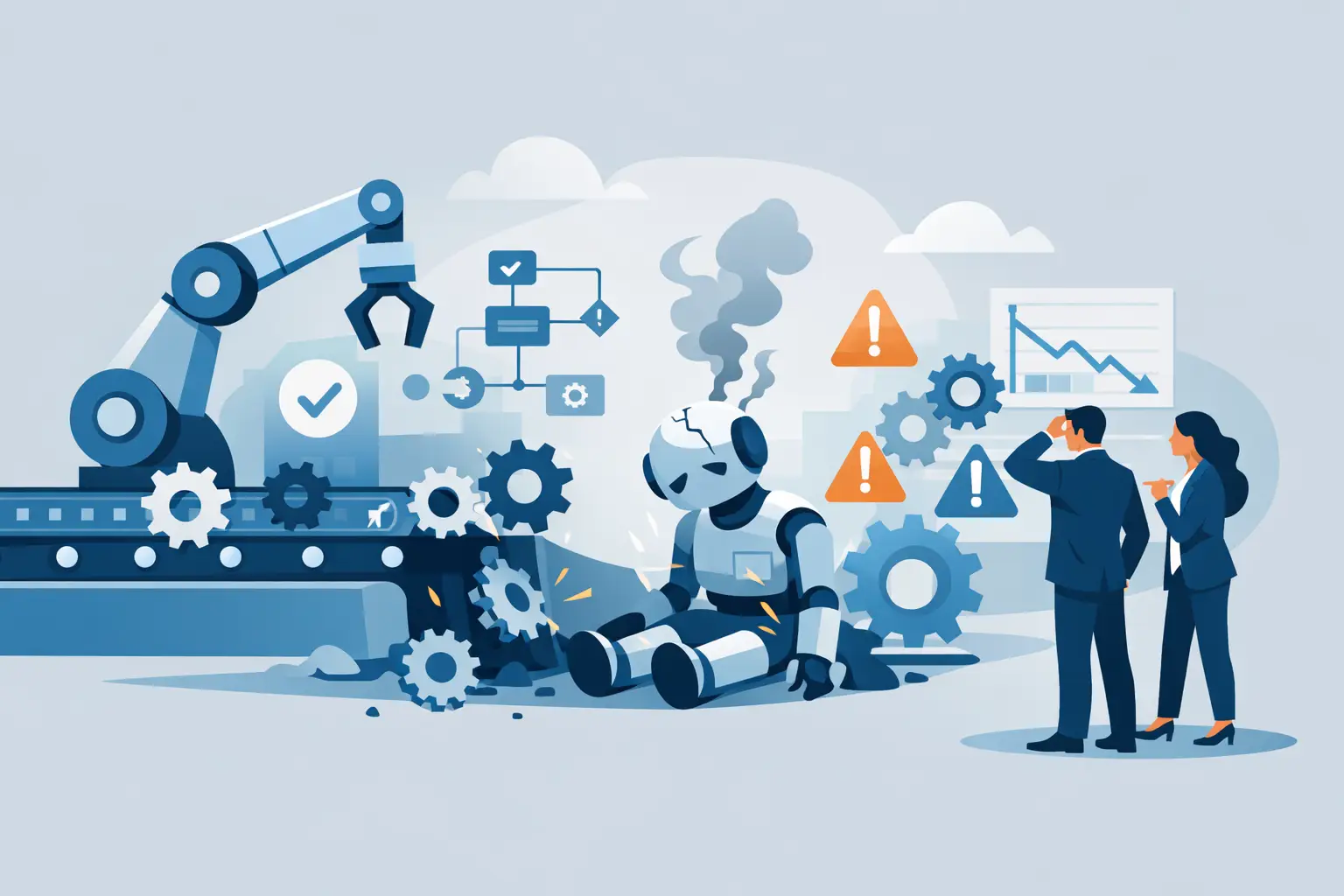
A company automates 20 tasks, publishes a success story internally, and then watches the program stall six months later. The bots start breaking, exceptions pile up, business teams lose confidence, and leadership begins to question the investment. That pattern is common, and it explains why so many leaders ask what causes automation programs to fail when the initial pilot looked so promising.
The short answer is this: automation rarely fails because of the software alone. It fails because enterprises try to automate unstable processes, poor data, fragmented ownership, and local workarounds. The technology exposes operational weaknesses that were already there. If those weaknesses are not addressed, the automation layer becomes one more thing to maintain instead of a scalable source of value.
What causes automation programs to fail in enterprise settings
In enterprise environments, failure usually does not show up as a dramatic shutdown. It shows up as slow erosion. Delivery times stretch. Rework increases. Each new automation takes longer than the last. Benefits become harder to measure. Eventually, the program is labeled as expensive, difficult to govern, or impossible to scale.
That is why the right question is not whether automation works. It does. The better question is whether the organization has built the conditions that allow automation to perform reliably at scale.
Automating broken processes
This is the most common issue and the most expensive one to ignore. Many organizations rush to automate a process because it is manual, repetitive, or high-volume. Those are valid candidates, but they are not enough on their own. If the process contains unnecessary approvals, inconsistent handoffs, duplicate data entry, or location-specific exceptions, automation will not fix the underlying inefficiency. It will simply execute that inefficiency faster.
In practice, this creates a false sense of progress. Teams see activity and deployment, but the actual operating model remains messy. Maintenance goes up because the automation has to account for every exception that should have been removed during process redesign.
A better approach starts with process simplification. Standardize the workflow, reduce variation where possible, define the exception paths, and then automate what is stable. This is less exciting than launching a bot quickly, but it is far more likely to produce durable ROI.
Weak data foundations
Automation depends on data quality more than most programs admit at the start. If master data is inconsistent, if documents arrive in multiple formats without clear rules, or if business systems hold conflicting versions of the same record, automations become fragile. They fail silently, route work incorrectly, or produce outputs that require manual correction.
This problem becomes more severe as organizations add AI or intelligent document processing. Leaders often expect these technologies to compensate for messy information. In reality, they can extend capability, but they do not remove the need for structured data governance.
For enterprise teams, data quality is not a technical side issue. It is a core design condition for automation. Good data definitions, clear ownership, integration discipline, and validation logic are what make automated decisions trustworthy.
Treating automation as a tool purchase
Another reason automation programs fail is that they are framed as technology deployments rather than business transformation programs. A platform is selected, a small center of excellence is formed, and the organization assumes value will follow. It usually does not.
Automation succeeds when it is connected to business priorities such as cycle time reduction, cost-to-serve improvement, control enhancement, service quality, or throughput capacity. Without that connection, teams optimize for deployment volume instead of business impact. They count bots, not outcomes.
This is also where vendor fragmentation causes problems. One partner handles process mapping, another handles data work, another configures the automation platform, and internal teams are left to connect the pieces. That model often creates handoff gaps, competing assumptions, and unclear accountability for results.
Why automation programs fail after a successful pilot
Pilots are supposed to reduce risk, but they can create a distorted picture. A pilot often focuses on a narrow process, a cooperative business unit, and a contained set of exceptions. It is built by the strongest available team, with high executive attention. That is not what enterprise scale looks like.
When organizations move from pilot to program, they encounter the real conditions of scale: inconsistent processes across regions, legacy systems with unstable interfaces, missing documentation, competing priorities, and governance demands from security, compliance, and IT. If the operating model was not designed for those realities, the pilot success becomes difficult to repeat.
No governance model for scaling
Governance is often misunderstood as control overhead. In strong automation programs, governance is what allows growth without chaos. It defines intake criteria, prioritization rules, architecture standards, exception management, release discipline, and ownership across business and IT.
Without it, automation demand becomes political. Teams push their own use cases forward. Developers create inconsistent patterns. Risk reviews happen late. Support models are unclear. Over time, delivery slows because every project is effectively custom.
Good governance does not need to be bureaucratic, but it does need to be explicit. The larger the organization, the more important that becomes.
Business ownership fades after go-live
Many automation initiatives are well supported during design and launch, then handed off too quickly. Once the automation is live, business teams return to daily operations while technical teams are expected to keep everything running. That separation is risky.
Processes change. Policy rules change. Source systems change. Customer requirements change. If business owners are not actively engaged, the automation becomes misaligned with the process it was built to support. The result is not always immediate failure. More often, it is a slow decline in accuracy, trust, and usage.
Sustainable automation needs named business ownership, clear performance metrics, and an agreed mechanism for change management. Automation is not a one-time asset. It is part of the operating model.
Benefits are vague or impossible to measure
Programs that cannot prove value eventually lose momentum. This sounds obvious, yet many organizations still define success in broad terms like efficiency, productivity, or digitization. Those goals are directionally useful, but they are not enough to defend investment decisions.
The stronger model is to define measurable outcomes from the start: hours removed, cycle time reduced, straight-through processing rate improved, error rate lowered, backlog eliminated, or compliance risk reduced. Then track those outcomes consistently through dashboards and operational reviews.
This matters for prioritization as much as reporting. If leaders cannot compare use cases on expected value, complexity, and strategic relevance, the portfolio fills with low-impact automations that consume delivery capacity.
The operational patterns behind failure
At scale, failed programs usually show the same patterns. Too many use cases are selected because they are easy to automate, not because they matter. Exception handling is underestimated. Documentation is weak. Support is underfunded. Security and architecture teams are involved too late. Local teams build workarounds that cannot be reused elsewhere.
None of these issues are unusual. The real difference is whether the organization treats them as isolated delivery problems or as signs that the operating model needs to mature.
For example, if automations repeatedly break after ERP changes, the lesson is not just to fix the scripts. It may mean the integration strategy is too dependent on unstable interfaces. If every deployment requires significant exception handling, the issue may be process variation, not development capacity. If the business keeps requesting one-off solutions, intake governance may be too weak to protect scale.
This is where a disciplined transformation approach matters. Process design, data architecture, automation engineering, and measurement need to work together. If they are separated, each team solves its own piece and the program accumulates friction.
How to prevent automation failure before it starts
The most effective prevention is not more enthusiasm for automation. It is more discipline before and during delivery.
Start with process qualification, not just opportunity identification. Ask whether the workflow is standardized enough to automate, whether exceptions are understood, and whether the upstream and downstream dependencies are stable. If the answer is no, fix the process first.
Then assess data readiness. Identify where key inputs come from, who owns them, how quality is monitored, and what controls are needed. If the automation depends on AI, be especially careful about confidence thresholds, escalation logic, and auditability.
Build a governance model that matches the scale of your ambition. Define who decides, who funds, who supports, and who approves architectural patterns. Set standards for reuse so every new solution does not start from zero.
Finally, measure value like an operations program, not a tech experiment. Tie each use case to business outcomes, baseline the current state, and track performance after deployment. That is how leaders know what to scale, what to redesign, and what to stop.
Organizations that get this right do not treat automation as a layer added on top of complexity. They use it as part of a broader operating model redesign. That is the difference between a promising pilot and a program that keeps delivering year after year. For enterprises under pressure to improve throughput, reduce cost, and increase control, that difference is where the real return is found.