If your automation program keeps stalling after a promising pilot, the problem is often not the bot, the dashboard, or the AI model. It is the foundation underneath. In the debate around data architecture vs data management, enterprise teams often treat them as interchangeable, then wonder why scaling becomes expensive, slow, and difficult to govern.
That confusion has real cost. A company can invest heavily in analytics, workflow automation, and reporting, yet still struggle with duplicate records, conflicting definitions, and disconnected systems. The result is familiar: manual rework, low trust in metrics, and digital initiatives that perform well in isolation but break under enterprise complexity.
Data architecture vs data management: what is the difference?
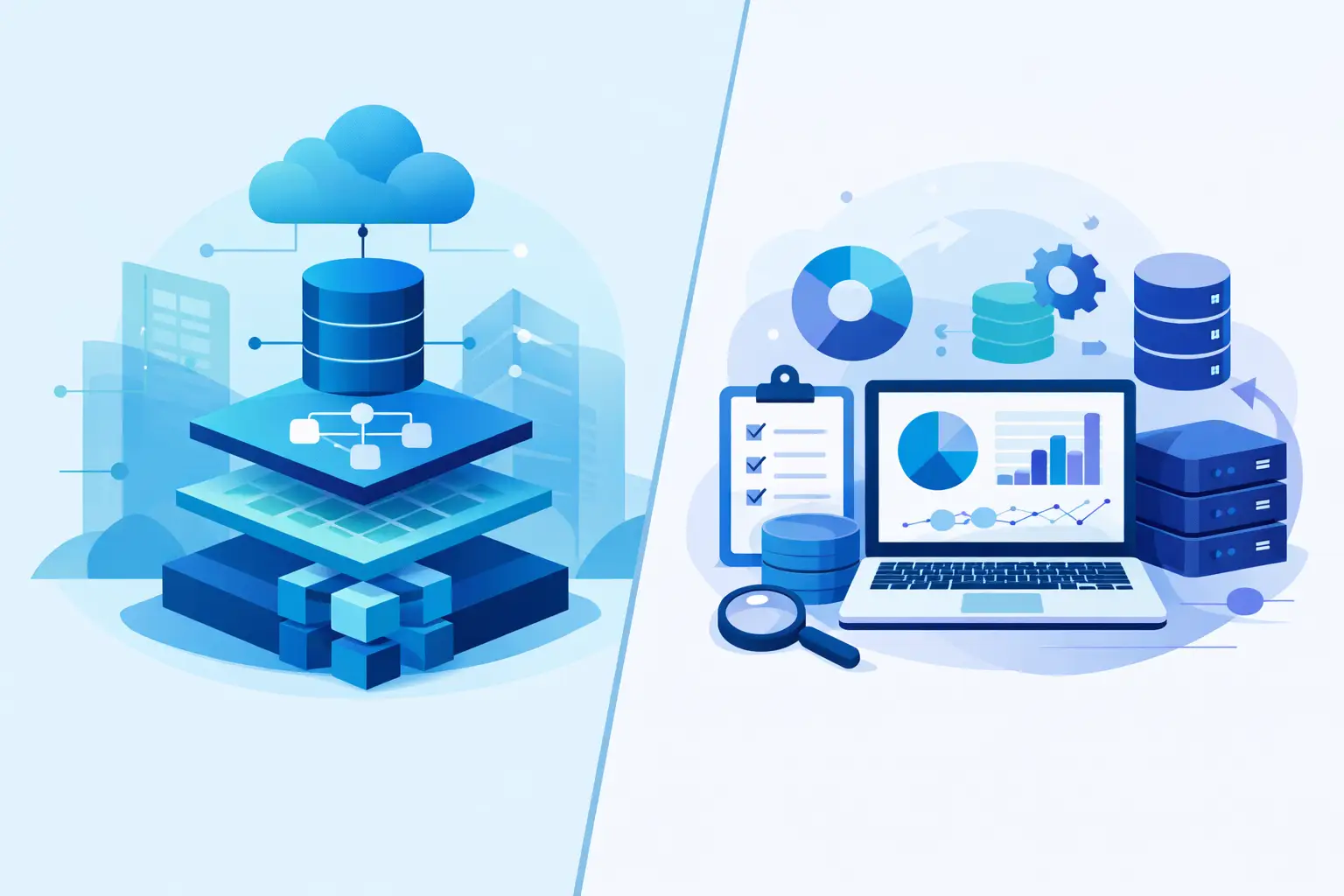
The simplest way to separate them is this: data architecture defines how data should be structured, connected, stored, and accessed across the business. Data management is the ongoing discipline of keeping that data accurate, usable, secure, governed, and fit for business operations.
Architecture is the blueprint. Management is the operating model.
That distinction matters because one without the other creates predictable failure points. Strong architecture with weak management produces elegant designs that degrade in day-to-day use. Strong management without architecture can keep critical processes alive, but usually through workarounds, local rules, and high administrative effort.
For enterprise leaders, this is not a semantic issue. It affects implementation speed, reporting accuracy, compliance exposure, and the total cost of scaling automation and AI.
What data architecture actually covers
Data architecture is concerned with the design choices that shape the flow of data across systems and business processes. It answers questions such as where master data should live, how operational and analytical data should interact, what integration patterns are acceptable, and which data models support current and future use cases.
In practice, this includes data domains, data models, storage layers, integration design, metadata structures, and standards for interoperability. It also includes decisions about whether the business will rely on centralized, federated, or hybrid data ownership models. These are not just technical choices. They influence operating efficiency, reporting consistency, and how quickly new use cases can be delivered.
A useful architecture reduces friction. Teams know where trusted data comes from. Interfaces are predictable. Business definitions are aligned. New dashboards, automations, or AI use cases do not require custom logic every time because the structural groundwork has already been done.
But architecture should not be mistaken for a one-time design exercise. Enterprise environments change. Systems are added after acquisitions. Reporting requirements shift. New regulations appear. A strong architecture accounts for change without turning every new requirement into a redesign project.
Why architecture failures show up in operations
When architecture is weak, operational symptoms appear quickly. Finance closes take longer because data has to be reconciled manually. Shared service teams maintain shadow files because source systems do not align. Process mining produces incomplete insights because event data is inconsistent. Automation teams hard-code exceptions because upstream data is too unreliable.
These are not isolated process issues. They are architectural signals.
What data management actually covers
Data management is the execution layer that keeps information useful after the architecture is defined. It includes data quality controls, governance policies, stewardship roles, lifecycle management, access management, retention, issue resolution, and monitoring.
If architecture defines the intended state, data management deals with the daily reality of making that state hold up in production. It determines how duplicate suppliers are prevented, how customer records are corrected, who owns a data definition, how data quality issues are escalated, and how policy is enforced across systems and teams.
This is where many transformation efforts fall behind. Businesses may approve a target architecture, but they do not establish ownership, controls, or accountability. Over time, standards are bypassed, local exceptions accumulate, and confidence in the data declines. Once trust is lost, users build side processes. That is when cost rises and scalability drops.
Good data management is operational by nature. It is measured through fewer errors, faster cycle times, cleaner handoffs, stronger auditability, and higher confidence in reporting. It creates the discipline that allows process automation and decision-making systems to perform reliably under volume.
Why management failures are expensive
Poor data management rarely appears first as a data problem. It shows up as delayed invoicing, disputed KPIs, missed service levels, and slow decision cycles. The business pays through wasted labor, higher exception handling, compliance risk, and technology underperformance.
That is why data management should not sit on the edge of transformation programs. It belongs in the core execution model.
Data architecture vs data management in transformation programs
In enterprise modernization, the most practical question is not which one matters more. It is which problem you are trying to solve first and how the two need to work together.
If your landscape is highly fragmented, architecture often needs immediate attention. Without structural clarity, every automation or reporting initiative becomes a custom integration exercise. Teams move slowly because they are designing around inconsistency rather than building on standards.
If your architecture is broadly sound but business users still distrust the data, management is usually the constraint. In that case, the issue is not where data sits. It is whether ownership, quality controls, and governance are strong enough to support scale.
In most cases, both need to move together. A target architecture without governance becomes theoretical. Governance without structural redesign becomes reactive and expensive.
This is especially true in operations-heavy businesses. High transaction volumes expose every weakness in the data layer. A small inconsistency in master data can produce thousands of downstream exceptions. An unclear data ownership model can delay issue resolution across finance, procurement, customer service, and operations.
Where enterprises get the model wrong
One common mistake is assigning architecture entirely to IT and management entirely to the business. That split looks clean on paper but fails in execution. Data architecture decisions affect business definitions, process design, and reporting logic. Data management decisions affect system rules, controls, and platform capabilities. Neither works well in a silo.
Another mistake is treating data quality as a cleanup phase after implementation. By then, the process design may already be dependent on bad assumptions. Clean data is not a finishing step. It is a prerequisite for automation, analytics, and AI that can be trusted.
A third mistake is overengineering architecture before validating business priorities. Not every environment needs a large-scale redesign upfront. Sometimes the right move is to stabilize critical data domains, define ownership, and fix process-level breakdowns first. It depends on business goals, system maturity, and the speed required for execution.
A practical operating model for both
For leaders trying to connect strategy with delivery, the most effective model starts with business process reality rather than technology preference. Identify the workflows that matter most to cost, control, service level, and visibility. Then map the data dependencies underneath them.
From there, architecture should define the target structure for those dependencies: source systems, integration logic, master data boundaries, reporting layers, and standards for reuse. Management should define who owns the data, how quality is measured, how exceptions are handled, and how policy is maintained over time.
This is where an integrated transformation partner adds value. When process redesign, data architecture, and data management are planned together, the result is not just a cleaner data model. It is faster throughput, lower manual effort, and more reliable automation. That execution model is central to how Ective approaches enterprise modernization.
How to decide where to focus first
If leadership is asking for faster automation delivery, better reporting, or stronger AI readiness, start by diagnosing the constraint honestly. If every initiative is slowed by inconsistent system structures, architecture likely comes first. If initiatives launch but fail in production because the data degrades, management needs priority.
The strongest programs usually sequence the work rather than separating it. They establish a pragmatic target architecture, improve critical data domains, assign business ownership, and embed governance into operational workflows. That is more effective than a large theoretical program that produces standards no one follows.
The right level of ambition also depends on scale. A mid-market company with a concentrated ERP landscape needs a different model than a global enterprise with multiple ERPs, regional processes, and legacy acquisitions. The principle stays the same, but the design choices should match the operating reality.
Data architecture and data management are not competing disciplines. One creates order by design. The other keeps that order working under pressure. If you want automation, analytics, and AI to deliver measurable business value, both have to be treated as part of the same execution system. Start where the operational pain is sharpest, but build with the full model in mind.