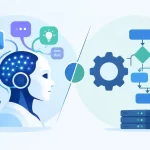
A plant manager asks why an AI copilot cannot produce a reliable production exception report. The answer is rarely the model. Order status sits in one system, inventory data in another, maintenance events arrive late, and teams use different definitions of downtime. This is the practical issue behind data foundation vs AI implementation: an enterprise cannot automate or augment decisions consistently when the underlying process and data are inconsistent.
For operations-heavy organizations, this is not an argument against AI. It is an argument for sequencing transformation work so that AI investments improve performance rather than add another disconnected layer to the technology stack.
Data Foundation vs AI Implementation: The Real Decision
The wrong question is, “Should we invest in data or AI?” Most enterprises need both. The more useful question is: what constraints are currently preventing better decisions, faster execution, and scalable automation?
A data foundation is the operating base that makes information usable across people, processes, and systems. It includes defined business data, ownership, quality controls, integration patterns, access rules, and the architecture needed to make trusted information available when work happens. It also requires agreement on the process that generates the data. If a purchase order changes hands through email, spreadsheets, and untracked exceptions, a data platform alone will not fix the ambiguity.
AI implementation applies machine learning, generative AI, document intelligence, or decision-support capabilities to a defined business outcome. It may classify invoices, summarize service requests, predict equipment failure, guide employees through procedures, or identify unusual transactions. These use cases can produce meaningful gains, but their results depend on the quality, completeness, and context of the inputs they receive.
The distinction matters because AI can create an impressive demonstration from a limited dataset while failing in daily operations. A solution that performs well for one business unit may become unreliable when introduced to multiple legal entities, ERP instances, languages, approval rules, and exception paths.
Why Process Comes Before Both
Enterprise data is not created in a vacuum. It is produced by workflows: a customer service agent updates a case, a planner changes a schedule, a warehouse team confirms a receipt, or finance resolves an exception. When those workflows are unclear, nonstandard, or heavily manual, the resulting data will carry the same weaknesses.
This is why transformation should start by examining the end-to-end process. Identify where transactions originate, where decisions are made, which exceptions require judgment, and where employees rekey or reconcile information. Then define the target process and the data required to operate it.
Consider accounts payable. An organization may want generative AI to answer supplier inquiries and document intelligence to extract invoice data. Those capabilities can help, but not if supplier master data is duplicated, payment status is delayed across systems, and exception reasons are free-text notes with no consistent categories. The immediate opportunity may be to standardize intake, define exception codes, connect relevant systems, and establish ownership for supplier data. AI then has a stable process to support.
This approach also prevents a common failure mode: automating a broken process at greater speed. Faster routing of unclear approvals or faster extraction into an uncontrolled workflow does not create efficiency. It expands the volume of work that still requires correction.
What a Usable Data Foundation Looks Like
A data foundation does not require a multi-year program before any business value appears. It requires a disciplined scope tied to priority processes. The goal is not to centralize every available record. The goal is to make the data needed for a high-value operational decision trustworthy, timely, and governed.
For a given use case, leaders should establish a clear data product: the defined set of information, metrics, ownership, quality expectations, and access rules that a team or automation depends on. For example, an order fulfillment data product may combine order lines, available inventory, shipment status, customer priority, and exception reasons. Each field needs an agreed definition and a responsible owner.
A practical foundation also addresses integration and timing. A dashboard based on prior-day data may be adequate for monthly capacity planning but inadequate for same-day order recovery. Similarly, an AI assistant that recommends next actions needs access to current policy documents, current transaction status, and the relevant customer or asset context. Architecture should reflect the speed and reliability required by the business process, not a generic technology preference.
Governance is equally operational. It means someone can answer simple but consequential questions: Who owns this field? What happens when it fails validation? Which system is the source of record? Who may use the data for an AI use case? How is sensitive information protected? These controls reduce the maintenance burden that often appears after an initial pilot is declared successful.
When AI Can Start Before the Foundation Is Complete
“Foundation first” should not become an excuse for delaying useful work indefinitely. Some AI initiatives can begin early when the process is bounded, the risk is manageable, and the input data is controlled.
A knowledge assistant for internal policies can be a sensible early use case if it draws from approved documents, has clear permissions, and directs employees to source material when confidence is low. Document classification can also work well when document types are limited and humans review uncertain outputs. These projects help teams build adoption, governance, and measurement practices while larger data improvements continue.
The trade-off is scope. Early AI projects should not make high-impact decisions without reliable data, auditability, and escalation paths. An assistant can draft a response to a supplier. It should not autonomously alter payment terms based on incomplete records. A forecasting model can flag likely stock issues. It should not replace planning judgment until its performance has been tested across normal variability, peak periods, and edge cases.
The right sequencing depends on four conditions:
- The business process has a defined owner and measurable outcome.
- The required data is available at sufficient quality for the intended decision.
- Exceptions can be routed to a person or controlled workflow.
- Security, access, and accountability requirements are clear.
If these conditions are met, an AI use case can deliver value while exposing exactly where the data foundation needs further work.
Measure the Business Outcome, Not the Model Activity
AI implementation programs often report activity metrics: users enabled, prompts submitted, documents processed, or models deployed. These indicate adoption, but they do not establish operational value.
Enterprise leaders should connect each initiative to process measures. In finance, that may mean touchless processing rate, exception resolution time, cost per invoice, or on-time payment performance. In customer operations, it may mean first-contact resolution, handling time, case backlog, and service-level adherence. In manufacturing, relevant measures may include schedule stability, unplanned downtime, scrap, and time to resolve quality issues.
A baseline is essential. Without one, a team cannot distinguish a genuine gain from seasonal volume shifts, staffing changes, or temporary workarounds. It should also track quality measures alongside speed. A faster classification process that sends more incorrect cases downstream is not a productivity gain.
This is where integrated delivery matters. Process redesign, data management, automation, AI, dashboards, and change management should reinforce one another. When different vendors own each layer without a shared operating model, enterprises often inherit fragmented accountability and expensive handoffs. A single transformation roadmap makes dependencies visible and helps teams prioritize work that produces measurable results.
A Practical Sequence for Enterprise Leaders
Start with one or two processes where transaction volume, manual effort, decision delays, or compliance risk are high. Map the current workflow across functions and systems. Quantify rework, waiting time, exception volume, and the cost of poor visibility.
Next, define the target operating process and the data required to manage it. Standardize definitions, establish ownership, and connect the systems that contain the relevant records. Automate predictable steps where rules are stable. This often creates immediate value before advanced AI is introduced.
Then apply AI where it improves a specific decision, interaction, or unstructured-data task. Design for human review where risk or uncertainty is high, and monitor outcomes after deployment. Expand only after the first implementation demonstrates that quality, governance, and economics hold under real operating conditions.
Ective approaches this sequence as an execution discipline: organize the workflow, structure the data, automate repeatable work, and apply AI where it materially improves performance. The result is not an isolated pilot. It is an operating capability that can be extended across functions and business units.
The strongest AI programs do not begin with a model selection exercise. They begin with a business process that deserves to work better, data that can support a trusted decision, and a clear standard for what better performance looks like. Build from there, and every subsequent AI investment has a far better chance of becoming part of daily operations rather than another promising demonstration.