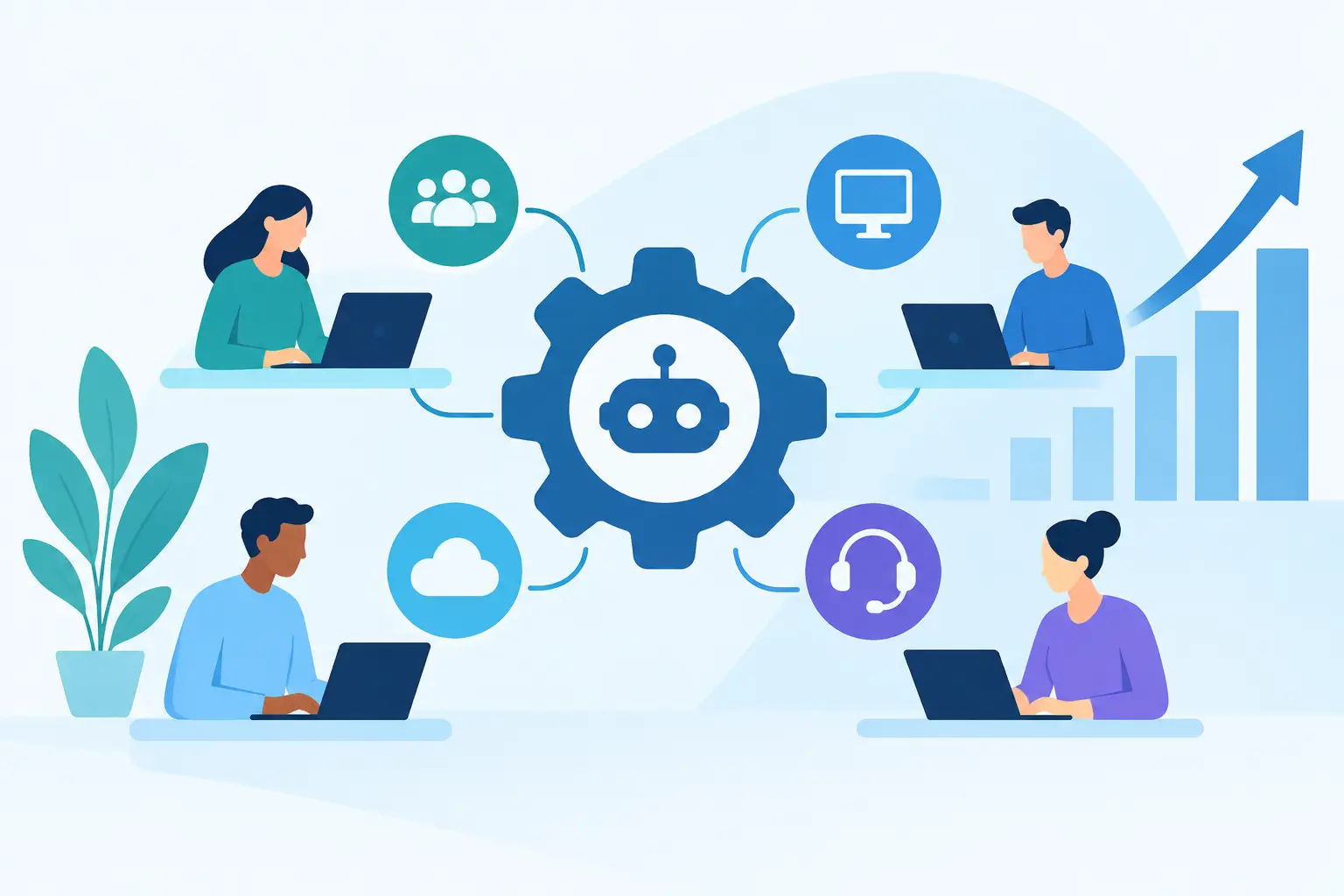
A shared services center rarely fails because teams lack automation ideas. It fails because a promising bot is applied to a fragmented process, inconsistent master data, and unclear ownership. This shared services automation guide focuses on the work that turns isolated efficiency wins into a controlled, scalable operating model.
For finance, HR, procurement, IT, and customer operations leaders, the objective is not simply to reduce manual effort. It is to create reliable, measurable services that can absorb volume, meet service levels, and provide management with a clear view of performance. Automation is a critical enabler, but it must sit on a stronger foundation: standardized processes, connected data, and governance that survives change.
Start With the Service, Not the Tool
Shared services automation should begin with a service-level question: where does work slow down, rework increase, or employees spend time moving information between systems? A technology-first approach often produces attractive demonstrations and disappointing operational results. The tool works, but the surrounding process remains unstable.
Take invoice processing. Automating invoice entry may reduce keystrokes, yet it will not resolve recurring exceptions caused by duplicate vendor records, missing purchase order data, or inconsistent approval rules. If those issues remain, the team simply receives exceptions faster. The result is a maintenance burden that grows as transaction volumes increase.
A better starting point is to map the end-to-end service, from request or document intake through validation, decision-making, fulfillment, exception handling, and reporting. Measure volume, touch time, wait time, error rates, handoffs, and the reasons work leaves the standard path. This establishes a business case based on operational evidence rather than assumed savings.
Choose Processes That Can Scale
The first automation candidates should combine meaningful volume with defined rules and a clear process owner. They should also have enough stability to support standardization. High-volume reconciliations, employee onboarding tasks, purchase order matching, master-data updates, and routine service requests are common examples.
However, volume alone is not enough. A low-volume process with material compliance exposure or repeated customer impact may deserve earlier attention. The right prioritization model considers value, feasibility, risk, data quality, integration requirements, and the expected level of change after deployment.
Avoid treating every process as a robotic process automation opportunity. Some workflows need redesigned forms, clearer policies, system integration, workflow orchestration, document intelligence, or analytics before they need a bot. In many cases, the best automation removes a handoff altogether rather than replicating it.
Build the Data and Process Foundation
Standardization is where shared services programs either gain scale or lose momentum. Regional variations, legacy approval matrices, local spreadsheets, and duplicate records create hidden complexity. Automating each variation separately may preserve local convenience, but it creates an expensive portfolio of exceptions and makes governance difficult.
Process owners should define a standard path, a limited set of justified variants, and explicit rules for exceptions. This does not mean forcing every business unit into an identical workflow. It means distinguishing between requirements that are genuinely regulatory or commercially necessary and practices that exist because systems or teams evolved independently.
Data requires the same discipline. Automation depends on accurate vendor, customer, employee, product, and financial data, as well as consistent document classifications and reference fields. Establish who creates, changes, approves, and retires critical data. Set validation rules at the point of entry, not after errors have moved downstream.
For enterprise environments, architecture decisions matter as much as process design. Determine which systems own the record, where integrations should be used, how workflow status is captured, and how audit trails are retained. Screen-based automation can be appropriate when legacy applications cannot be integrated quickly. It should not become a substitute for an integration strategy when APIs or workflow platforms can provide a more durable solution.
Design the Shared Services Automation Operating Model
Automation at scale needs operating ownership beyond the project team. The shared services leader owns service outcomes. Process owners define policies and standard work. IT and security teams govern access, architecture, and change control. Data owners maintain quality. A center of excellence can set standards and provide reusable capabilities, but it should not become a bottleneck for every improvement.
The most effective model combines central standards with accountable business ownership. Central teams establish design principles, reusable components, monitoring practices, and vendor controls. Service teams remain responsible for performance, adoption, and the exceptions that automation exposes.
Governance should be proportionate to risk. An automation that sends payment instructions needs stronger segregation of duties, credential controls, and approval evidence than one that routes an internal request. Both need logging, ownership, and a defined support path. The difference is the depth of control, not whether control exists.
This is also where AI requires practical boundaries. AI can classify documents, extract information, summarize cases, recommend routing, and support agents with knowledge retrieval. For decisions with financial, employment, legal, or compliance consequences, leaders should define confidence thresholds, human review requirements, and traceability standards. AI should improve throughput without weakening accountability.
Implement in Releases, Then Prove the Value
Large transformation programs often lose credibility when benefits are promised early and measurement arrives late. A release-based approach reduces that risk. Start with a defined service domain, establish a baseline, implement the redesigned workflow, and measure results before expanding to the next domain.
A useful baseline includes cost per transaction, cycle time, first-time-right rate, backlog, service-level attainment, exception rate, and capacity released. For processes involving customers or employees, add satisfaction and resolution measures. For compliance-sensitive work, track control failures and audit findings.
Benefits should be measured at the operating level, not only through estimated hours saved. If capacity is released but backlog stays flat, the organization may have absorbed demand growth, improved control quality, or shifted people into higher-value work. That can still be valuable, but it should be stated clearly. Honest measurement creates better investment decisions than inflated automation claims.
Ective approaches this work as an integrated execution program: improve the process, organize the data, connect the architecture, and then apply automation and AI where they produce measurable service outcomes. That sequence reduces rework and creates a platform for broader modernization.
Plan for Exceptions Before Go-Live
The standard path may handle most transactions, but exceptions determine whether operations teams trust the new model. Define what happens when a document is unreadable, data is missing, a rule conflicts, a system is unavailable, or a confidence score falls below the approved threshold.
Each exception needs an owner, a queue, a service target, and a feedback mechanism. Repeated exceptions are not merely operational noise. They are evidence of a broken rule, weak data, unclear policy, or process variant that should be addressed. Teams that analyze exceptions systematically improve automation performance over time without adding unnecessary complexity.
Make Visibility a Management Discipline
A shared services center cannot manage what it cannot see. Dashboards should show the operational reality of each service: incoming demand, completed work, aging backlog, exceptions, service-level performance, and automation health. Leadership needs a view across services, while supervisors need enough detail to intervene during the day.
Do not overload dashboards with activity metrics that look positive but say little about outcomes. A rising number of automated transactions may appear successful while exceptions, rework, or customer wait times increase. Pair automation rates with quality, speed, and control measures to understand whether performance is actually improving.
Visibility also supports continuous improvement. When a service experiences delays, managers should be able to identify whether the cause is demand, staffing, approval behavior, data quality, an upstream system, or automation failure. This turns performance conversations from opinion into action.
Treat Scale as a Product, Not a Project
Once the first services are stable, reuse becomes the main source of speed. Common workflow patterns, approval components, document models, integration standards, testing practices, and monitoring controls should be designed for reuse from the start. This enables expansion without rebuilding the operating model for every process.
Still, scale should not mean automating everything. Some activities should be retired, consolidated, moved into a core system, or redesigned as self-service. Others require human judgment and should be supported by better information rather than replaced. The strongest shared services organizations make those choices deliberately.
A practical next step is to select one service with measurable friction, appoint an accountable owner, and establish the current-state baseline before choosing the technology. That discipline gives automation a clear job to do and gives leadership evidence that the program is ready to grow.