A plant manager wants a reliable view of inventory, production delays, supplier performance, and maintenance risk. Finance wants the same numbers to reconcile with the ERP. Customer service needs current order status without submitting a ticket to IT. This is where the data fabric versus data mesh decision becomes practical: it determines how quickly trusted data can support work across the enterprise, and who is accountable when it does not.
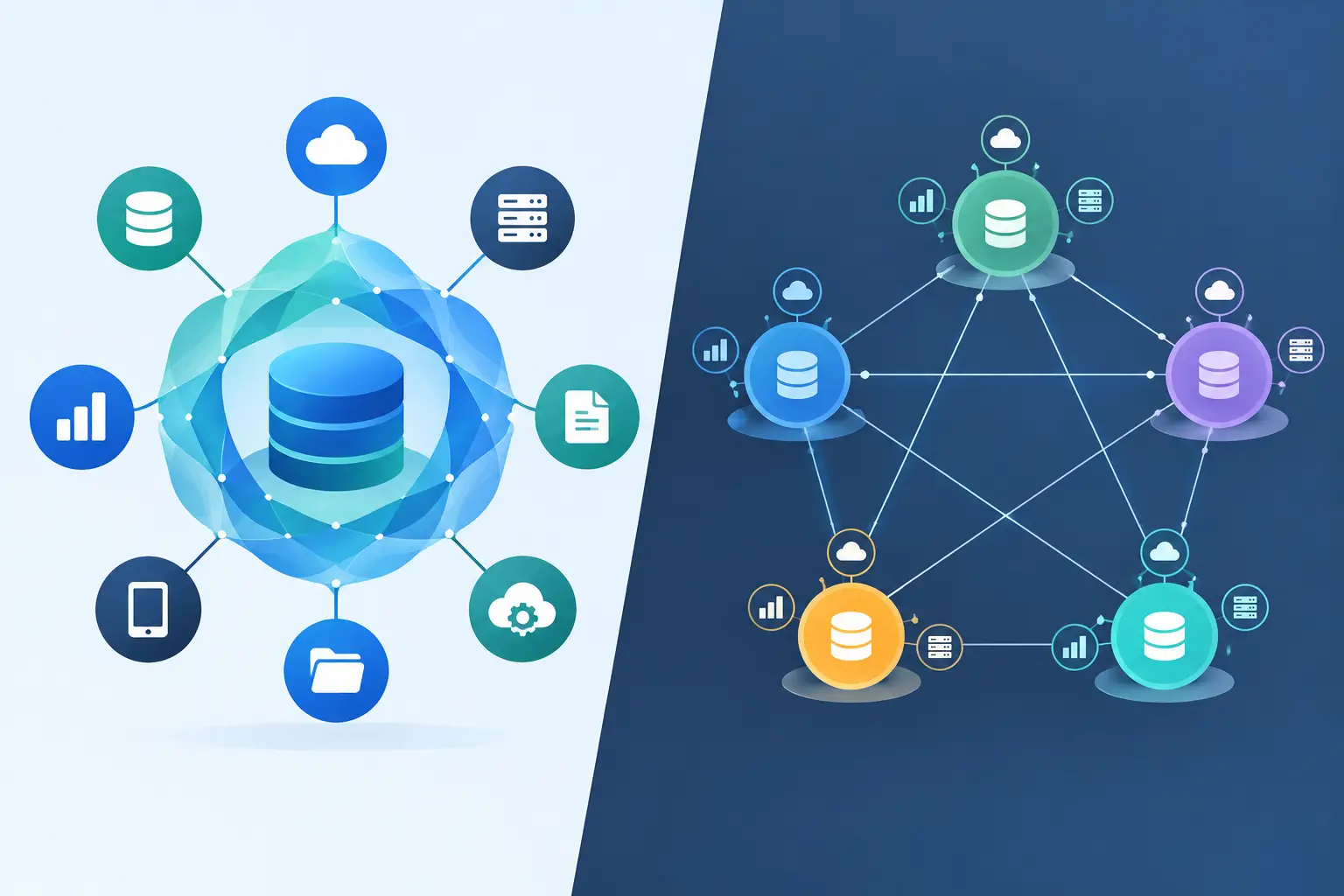
Neither approach is a software product or a shortcut around poor data management. Both can improve access to data across fragmented systems. The difference is in the operating model. A data fabric emphasizes connected, automated data management across the organization. A data mesh distributes ownership of data products to the business domains that create and understand the data.
For operations-heavy enterprises, the right choice depends less on market terminology and more on process maturity, governance capacity, system complexity, and the business outcomes the data program must support.
Data Fabric Versus Data Mesh: The Core Difference
A data fabric is an architectural approach for integrating, governing, and delivering data across multiple sources. It uses metadata, data catalogs, integration pipelines, semantic models, and automation to make distributed data easier to find, understand, and use. The goal is a connected data layer that reduces the effort of moving between ERP, CRM, manufacturing systems, documents, cloud platforms, and legacy applications.
In practice, a fabric often gives enterprise teams a more consistent way to identify data, apply quality controls, manage access, and serve information to dashboards, automation workflows, analytics, and AI use cases. It is particularly valuable where the same operational question requires information from many systems.
A data mesh is a decentralized data operating model. Rather than treating data as something a central team collects and prepares for everyone else, it assigns domains responsibility for publishing usable data products. Procurement owns supplier data products. Manufacturing owns production data products. Finance owns financial performance data products. Each domain is expected to provide data that is discoverable, understandable, governed, and fit for use by others.
The mesh model is built on four practical ideas: domain ownership, data as a product, self-service data infrastructure, and federated governance. It aims to eliminate the central data team as a delivery bottleneck without sacrificing enterprise standards.
The distinction matters. A fabric primarily answers, “How do we connect and manage our distributed data estate?” A mesh primarily answers, “How do we distribute accountability for data quality and usability at enterprise scale?” A mature organization may use both.
When a Data Fabric Is the Better Starting Point
A data fabric is often the stronger first move for enterprises dealing with fragmented systems, inconsistent definitions, and limited data ownership. These conditions are common after years of acquisitions, regional process variations, ERP customizations, and department-led technology purchases.
Consider a shared services organization processing high volumes of invoices, purchase orders, claims, or service requests. The information needed to automate and monitor those processes may sit across an ERP, a document repository, email, workflow tools, supplier portals, and spreadsheets. Before assigning data product ownership to multiple domains, the organization needs a dependable way to connect those sources, establish common identifiers, document definitions, and enforce access controls.
A fabric supports that foundation. It can reduce manual data preparation, improve lineage, and make trusted information available for common use cases such as working-capital reporting, exception management, process mining, or AI-assisted document handling. It also helps central teams identify where records conflict and where critical fields are incomplete.
This does not mean centralizing every dataset in one physical platform. A well-designed fabric can connect data where it resides while applying consistent metadata and governance. That is useful for enterprises that must retain data in specific systems for regulatory, operational, or cost reasons.
The trade-off is organizational. A centrally managed fabric can become another IT-owned service queue if business teams are not involved in defining data quality rules and priorities. Technology may connect systems successfully while operational teams still disagree about what “on-time delivery,” “active customer,” or “available inventory” means. Architecture cannot resolve a missing business decision.
When a Data Mesh Can Create More Value
A data mesh is most effective when an enterprise has distinct business domains with capable leaders, clear accountability, and enough scale to justify decentralized delivery. It works best when data is not simply an IT output but a managed business asset tied to operational performance.
For example, a global manufacturer may have separate but interdependent domains for engineering, supply chain, production, quality, sales, and aftermarket service. Each domain generates data with specialized context. The quality team understands defect classifications. Supply chain understands supplier lead-time exceptions. Service teams understand installed-base and warranty status. Asking one central team to model every detail, answer every question, and publish every dataset can slow down decision-making.
Under a mesh model, these domains publish data products with documented definitions, service expectations, ownership, and quality measures. A supply chain data product might provide approved supplier performance metrics, lead-time history, and current delivery risk. Finance and operations can use it with confidence because its owner, refresh frequency, permitted use, and quality thresholds are explicit.
The benefit is speed with accountability. Domain experts maintain the data closest to the process, while consumers can find and use it without rebuilding the same extracts in every department.
The trade-off is substantial. A mesh requires more than assigning owners in a governance presentation. Domain teams need skills, capacity, product management discipline, and shared technical standards. Without self-service tooling and enforceable governance, decentralization can produce multiple versions of the same metric, inconsistent security practices, and an expensive collection of local pipelines.
A data mesh should not be used to formalize existing silos. If every domain publishes data in its own format and vocabulary, the enterprise has distributed fragmentation rather than distributed value.
Architecture and Ownership Must Work Together
The most useful decision is rarely data fabric or data mesh as mutually exclusive options. Data fabric capabilities can provide the infrastructure and governance layer that makes a mesh viable. A mesh operating model can provide the business ownership that keeps a fabric from becoming a technically elegant but poorly adopted platform.
This combined approach is especially relevant when the enterprise wants to scale automation and AI. An intelligent automation program needs more than access to source data. It needs clear definitions, reliable records, approved access, traceable transformations, and process owners who can act on exceptions. GenAI applications add another requirement: they must retrieve information from authorized, current, well-classified sources rather than uncontrolled document collections.
A practical model might centralize common capabilities such as identity and access management, metadata management, master data rules, integration standards, observability, and the semantic layer. Business domains then own the quality and lifecycle of the data products most closely tied to their processes. Central standards remain firm, while accountability sits where operational knowledge exists.
This structure also supports measurable delivery. Instead of judging the program by the number of datasets ingested or dashboards published, define outcomes such as fewer manual reconciliations, faster month-end reporting, lower invoice exception rates, reduced order-to-cash cycle time, or faster response to production disruptions.
How to Make the Decision Without Starting Another Platform Program
Start with business processes, not architecture diagrams. Identify the cross-functional processes where poor data creates delay, rework, risk, or missed revenue. For a manufacturer, that may be forecast-to-plan, procure-to-pay, or quality incident management. For a healthcare provider, it may be referral management, claims operations, or capacity planning.
Then assess the current foundation. Can teams identify the authoritative source for key entities? Are business definitions agreed upon? Is lineage available for critical reports? Can approved users access information without repeated manual extraction? If the answer is largely no, fabric capabilities and core data governance are likely the priority.
Next, assess organizational readiness for distributed ownership. Do domains have named leaders who can own data quality decisions? Can they dedicate people to maintain data products? Are performance measures aligned so teams benefit from sharing information rather than protecting it? If not, a full mesh rollout will create commitments the organization cannot sustain.
A phased approach is usually more effective than a wholesale redesign. Choose one high-value process with clear sponsors and measurable pain. Establish its definitions, data quality rules, access model, and delivery requirements. Build the necessary integration and metadata capabilities. Then assign ownership based on where the business knowledge and decision rights actually reside.
Ective approaches this work as an execution discipline: process redesign, data architecture, governance, automation, and measurement must reinforce each other. A data model that is disconnected from the operating process will not produce lasting improvement, regardless of the platform behind it.
Build for Decisions, Not for Data Volume
The strongest data strategy is the one that helps a manager make a better decision before the operational window closes. For some enterprises, that starts with a data fabric that brings order to a complex technology estate. For others, it means giving capable domains responsibility for data products through a mesh model. For many, it means building the shared foundation of a fabric while progressively establishing mesh-style ownership where it delivers clear business value.
Choose the model that your organization can govern, operate, and measure. Then prove it in the processes where trusted data can remove friction from work every day.