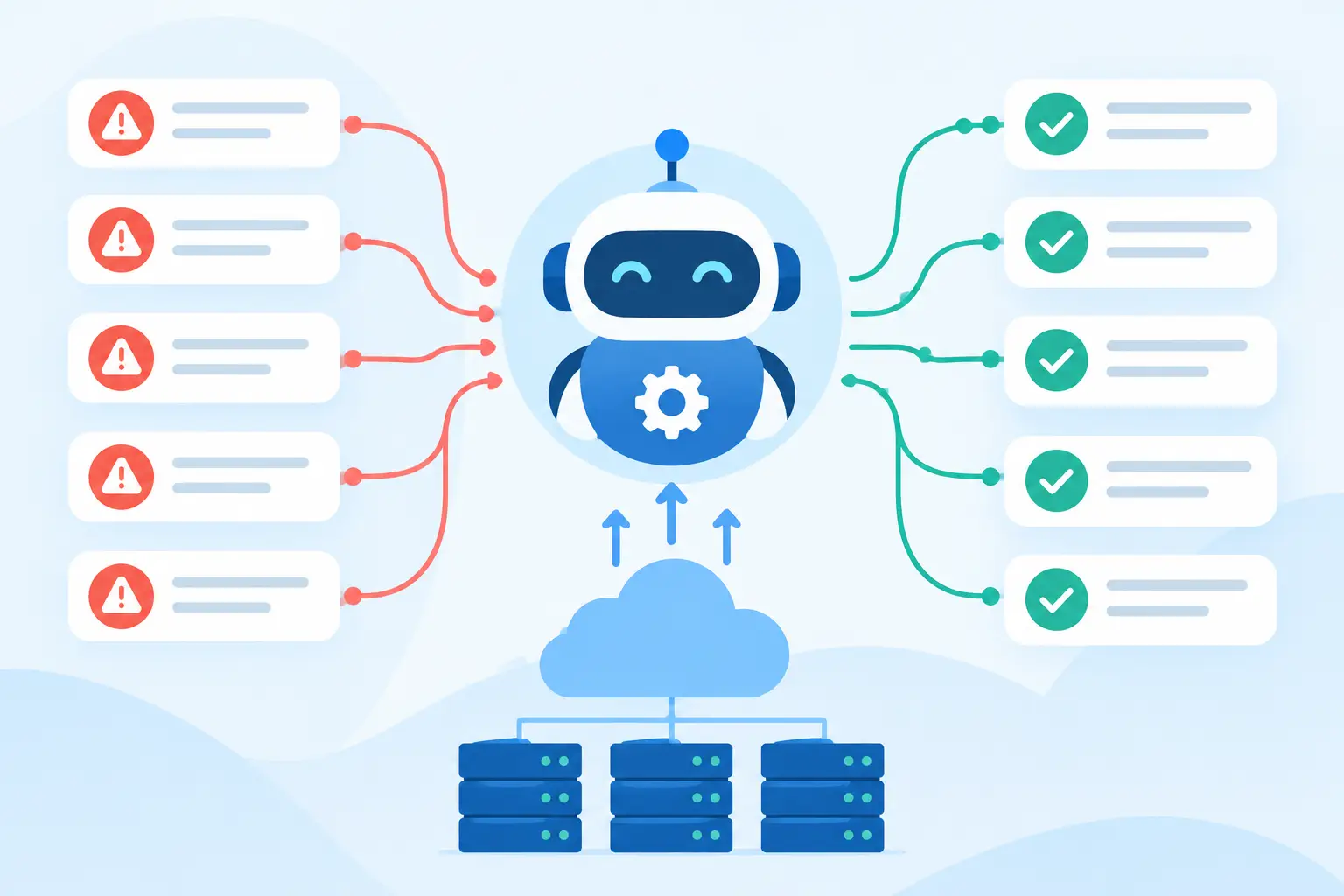
A purchase order with a missing cost center, an invoice that exceeds tolerance, a customer record with conflicting data: these are not edge cases in enterprise operations. They are where manual work accumulates, service levels slip, and automation programs lose credibility. Knowing how to automate exception handling is therefore less about removing people from the process and more about directing their attention to the decisions that genuinely require judgment.
The strongest exception-handling programs treat exceptions as operational signals. They reveal where data is incomplete, process rules are unclear, upstream controls are weak, or policies no longer reflect how the business operates. Automation can resolve a large share of these cases, but only when the organization has designed the process, data, ownership, and governance around it.
Start with the exception economics
Many teams begin by selecting a workflow tool or adding AI to an approval queue. That approach often produces a faster version of a broken process. Before automating, quantify the operational cost of exceptions: their volume, handling time, rework rate, aging, financial impact, and effect on customers or suppliers.
A useful starting point is to separate exceptions by both frequency and consequence. A high-volume, low-risk exception, such as a recurring formatting mismatch in a supplier file, may be an ideal candidate for automated correction. A low-volume exception involving payment terms, regulated data, or a material contract deviation may require controlled human review. The goal is not to automate every exception. It is to apply the right level of automation to each type of decision.
This analysis also exposes the true source of work. If accounts payable staff repeatedly correct the same vendor master-data issue, routing those invoices more efficiently is not the complete answer. The better answer may be a validation rule at supplier onboarding, a data stewardship workflow, or a change to the integration that creates the incorrect record.
How to automate exception handling with a clear taxonomy
Exception handling becomes manageable when exceptions are defined consistently across systems and teams. Without a shared taxonomy, one team may label a case as a data issue while another calls it a policy exception. Reporting becomes unreliable, and automation rules become difficult to maintain.
Create a practical classification model that captures the exception type, source system, business process, risk level, likely cause, required action, and accountable owner. Keep the model detailed enough to support decisions but simple enough for operations teams to use every day.
Separate known exceptions from unknown events
Known exceptions have established patterns. Examples include duplicate invoices, missing purchase order references, price variances within a defined range, and incomplete customer fields. These can usually be detected through business rules, data validation, process mining findings, or machine learning models trained on historical outcomes.
Unknown events are different. They may indicate a new supplier behavior, a system integration failure, a change in customer demand, or potential fraud. These cases should not be forced through a rule set designed for familiar scenarios. Route them to an accountable team, preserve the context, and use the outcome to determine whether a new exception category or control is needed.
Define resolution paths before building automation
Every category needs a resolution path. That path should state what information is required, which rules determine the next action, who can approve an override, when escalation is required, and how the outcome is recorded.
For example, an invoice-price variance might be automatically cleared if it is below a defined threshold and the supplier has a strong compliance history. A larger variance could trigger a request for supporting documentation. If the case remains unresolved after a service-level deadline, it may move to procurement or finance leadership. The routing logic must reflect business policy, not the limitations of a single application.
Build the decision layer on reliable data
Exception automation is only as dependable as the data used to make decisions. Fragmented master data, inconsistent identifiers, and delayed system updates create false positives and false negatives. A workflow may appear efficient while sending employees incorrect tasks or approving cases that should have been stopped.
Establish the data elements that each exception decision requires. For an order-to-cash process, that may include customer master data, contract terms, credit status, delivery confirmation, pricing conditions, and dispute history. For procure-to-pay, it may include supplier records, purchase order data, goods receipts, tax data, tolerance policies, and approval authority.
Then determine where the authoritative data sits and how it will be made available. In some cases, real-time integration is necessary because the decision affects a payment hold or production release. In others, scheduled synchronization is sufficient. The choice depends on the operational risk of acting on stale information.
Data quality controls should run before and during exception handling. Required-field checks, duplicate detection, format validation, reference-data matching, and reconciliation rules can prevent many exceptions from entering the queue. This is where process improvement and data management create more value than simply expanding the automation footprint.
Design automation in layers, not as a single workflow
At scale, exception handling needs several forms of automation working together. Rules-based automation is appropriate where policy is explicit and outcomes are predictable. Intelligent document processing can extract missing information from invoices, claims, or correspondence. AI can classify unstructured requests, summarize case history, recommend next actions, or identify unusual patterns. Workflow orchestration coordinates tasks across enterprise systems and teams.
Each layer should have a defined role. AI may recommend a resolution, but a policy engine should enforce approval thresholds. A workflow platform may assign work, but it should not become the only place where business rules are documented. Human reviewers need the case context, supporting evidence, prior actions, and a clear explanation of why the system proposed a decision.
Confidence thresholds are essential. If an AI model classifies a customer dispute with high confidence and the financial exposure is low, the system may route it directly to a standard resolution. If confidence is low or exposure is high, the case should move to a specialist. This risk-based model protects control while reducing manual effort.
Put ownership and controls into the operating model
Automation fails when exception queues become a shared responsibility with no actual owner. Every exception category should have a business owner accountable for policy, thresholds, and outcomes. Process owners define the standard path. Data owners address recurring data defects. Operations teams resolve cases within agreed service levels. IT and automation teams maintain integrations, monitoring, and change controls.
Governance does not need to slow the process. It should make changes traceable and safe. Maintain version control for rules, record automated decisions and overrides, require approvals for material threshold changes, and test new logic before production deployment. For regulated or financially sensitive workflows, audit trails must show the data used, the rule or model applied, the decision made, and the person who intervened when automation stopped.
Human-in-the-loop design is especially valuable during early rollout. Reviewers can validate recommendations, identify missing rule conditions, and distinguish genuine exceptions from poor data. Their feedback should be captured as structured data, not left in email threads or free-text notes that cannot improve the process.
Measure outcomes that change operating performance
A low exception count is not automatically a success. Cases may simply be hidden, reclassified, or routed around the measurement process. Track a balanced set of indicators: exception rate per transaction, straight-through processing rate, average resolution time, queue aging, first-time-right resolution, rework, override rate, and value at risk.
Also measure recurrence. If the same root cause continues to produce exceptions, the organization has automated the symptom rather than removed the failure point. A monthly review of high-volume categories, costly cases, and rising trends creates a disciplined improvement cycle.
For leadership teams, real-time visibility matters because exceptions often signal broader operational issues. A sudden increase in blocked invoices may reveal a supplier-data problem. A spike in credit exceptions may indicate a change in customer risk. A growing number of production-planning overrides may point to inaccurate demand or inventory data. Connected dashboards turn the exception queue into an early-warning system rather than an administrative backlog.
Know where automation should stop
Not every exception should be resolved without human involvement. Legal interpretation, material commercial concessions, safety-related decisions, major customer commitments, and cases with incomplete evidence often need experienced judgment. Trying to automate these decisions can create financial exposure and erode accountability.
The practical test is straightforward: can the organization explain the decision rule, trust the available data, and accept the consequence if the system acts incorrectly? If the answer is no, automate the preparation, evidence gathering, routing, and documentation, while retaining a controlled human decision.
The most valuable exception-handling programs do not aim for a queue with no people in it. They aim for a queue where people spend time on decisions that protect revenue, compliance, customer relationships, and operational continuity. Build that discipline first, and automation becomes a scalable source of control and performance rather than another layer of technology to manage.