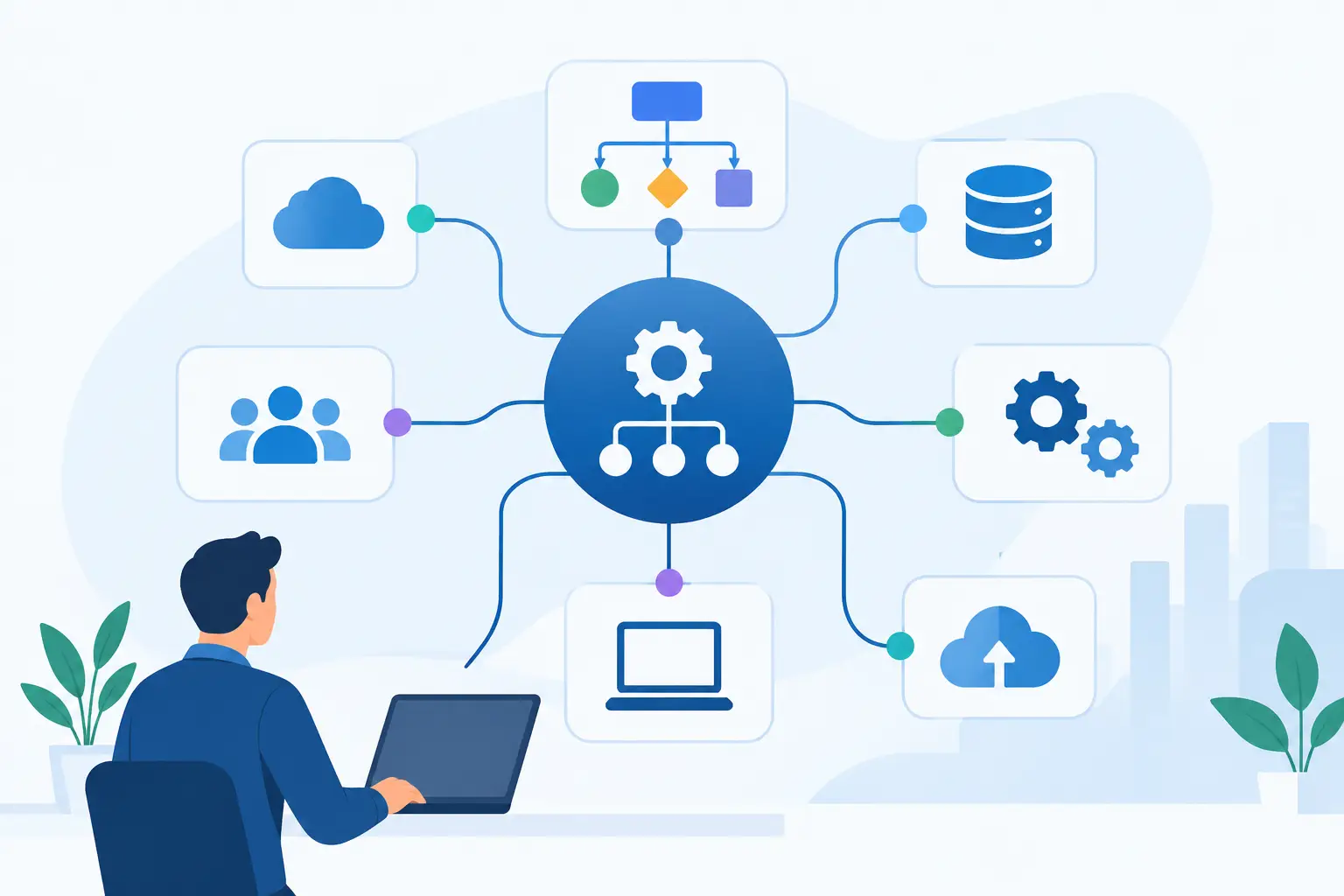
A procurement request that begins in a portal, triggers a credit check in an ERP, requires an approval in a workflow tool, creates documents, and updates a supplier record should not depend on employees chasing emails between systems. An enterprise process orchestration platform coordinates that work as one managed operation. It connects people, applications, data, rules, and automation so the process progresses reliably from trigger to outcome.
For operations leaders, the value is not another dashboard or isolated automation bot. It is the ability to run high-volume, cross-functional processes with clear ownership, controlled exceptions, and measurable performance. That distinction matters when shared services, finance, supply chain, customer operations, and IT all depend on the same workflow but operate in different systems.
What an enterprise process orchestration platform does
Process orchestration is the coordination layer above individual tasks and technologies. A platform directs the sequence of work, determines which system or person acts next, applies business rules, manages approvals, and records what happened. It also provides a common operational view of the process from start to finish.
Consider an order-to-cash process. An RPA bot may enter a customer order into a legacy application. An integration service may pass order data to the warehouse system. A document AI model may extract information from a purchase order. Each capability can be useful, but none of them alone manages the end-to-end process. Orchestration decides how those components work together, what happens when a validation fails, who resolves an exception, and when the case can move forward.
A capable platform generally brings together workflow management, business rules, integrations, task routing, document and data handling, automation services, monitoring, and audit history. The exact mix depends on the operating model. A manufacturing business may prioritize supplier onboarding and quality workflows. A healthcare organization may focus on case coordination, compliance checkpoints, and secure information handling. The common requirement is controlled execution across systems that were not designed to operate as one process.
Why isolated automation programs stop short
Many automation programs show early gains, then struggle to expand beyond a handful of use cases. The problem is often not the bot, AI model, or low-code tool. It is the lack of a process design and data foundation that can support scale.
When every department selects its own tools and builds local automations, the enterprise accumulates disconnected logic. Rules are duplicated. Exceptions move to inboxes. Data definitions differ between applications. When a policy changes, teams must identify and update numerous scripts, workflows, and manual instructions. Maintenance rises while visibility falls.
An orchestration approach addresses this by treating the process as a managed product rather than a collection of task automations. It creates a central model for the workflow, its decision points, service levels, owners, data requirements, and performance measures. That model does not eliminate departmental flexibility, but it establishes the standards needed to operate at enterprise scale.
This is also why process redesign must come before broad automation. Automating a process with unclear ownership, unnecessary approvals, and inconsistent master data simply makes poor execution happen faster. The better sequence is to simplify the workflow, define the required data, standardize decisions where appropriate, and then automate the repeatable work.
The operating model behind effective orchestration
Technology alone cannot resolve process fragmentation. Enterprises need clear decisions about ownership, governance, and change management. The most effective programs establish a process owner with responsibility for end-to-end outcomes, even when multiple functions perform the work.
That owner should be able to answer practical questions: What event starts the process? Which data is authoritative? Which decisions can be automated? What exceptions require human judgment? How long should each stage take? What evidence is required for audit or compliance?
A disciplined orchestration model has four connected layers:
- Process design: The future-state workflow removes unnecessary handoffs, clarifies roles, and defines standard and exception paths.
- Data and decisioning: Common data definitions, validation rules, and decision logic reduce rework and prevent conflicting actions across systems.
- Execution services: Integrations, automation, human tasks, and AI capabilities perform work through governed interfaces.
- Operational intelligence: Real-time metrics show volume, aging, bottlenecks, exception rates, and service-level performance.
These layers should be designed together. A workflow cannot produce reliable real-time insight if its status data is incomplete. AI-assisted decisions cannot be trusted if the source data is inconsistent or the human review path is undefined. Similarly, an automation cannot be considered production-ready if exceptions disappear into an unmanaged queue.
Where an enterprise process orchestration platform creates value
The strongest use cases share a few characteristics: high transaction volumes, frequent handoffs, several systems of record, measurable service levels, and costly exceptions. Finance operations are a common example. Invoice handling may involve document intake, extraction, purchase order matching, coding, approvals, exception resolution, payment release, and supplier communication. Orchestration turns these disconnected activities into a visible flow with accountable queues and decision controls.
Employee and supplier onboarding are also well suited. These processes cross HR, legal, procurement, IT, security, and finance. Without coordination, stakeholders rely on emails and spreadsheets to determine status. With orchestration, the process can route tasks based on role, location, risk level, or contract type, while maintaining a complete record of approvals and required documents.
In industrial operations, orchestration can coordinate service requests, warranty claims, quality incidents, and engineering changes. The goal is not to replace specialist systems. It is to ensure that the right work reaches the right system and person at the right point, with the necessary context attached.
The business case should be based on more than labor reduction. Useful measures include cycle time, first-pass completion, cost per transaction, exception aging, compliance adherence, customer response time, and the effort required to change the process. A process that saves hours but becomes difficult to maintain may not deliver the expected long-term return.
Selecting the right platform architecture
There is no universal platform choice. Some organizations need deep workflow and case-management capabilities. Others need stronger integration coverage, decision management, or document intelligence. Existing investments matter as well. An enterprise with a mature ERP and integration layer may require an orchestration platform that complements those systems rather than duplicates them.
The key is to assess the platform against real process scenarios, not feature checklists. Ask vendors and implementation partners to demonstrate how the platform handles an incomplete request, a failed integration, a reassigned approver, a policy exception, and a change to a business rule. Happy-path demonstrations reveal little about enterprise readiness.
Architecture should also account for scale and control. The platform needs role-based access, traceability, monitoring, environment management, and a clear approach to versioning. If citizen development is part of the strategy, guardrails are essential. Local teams should be able to improve approved workflows without creating ungoverned process variants or exposing sensitive data.
AI capabilities require the same discipline. Generative AI can improve document interpretation, employee support, and drafting of routine communications. It should not become an unobservable decision-maker in a regulated or financially material workflow. Define where AI assists, where rules decide, and where a qualified employee must approve the outcome.
A practical path from pilot to enterprise scale
A successful first release should be meaningful enough to prove operational value but bounded enough to control risk. Choose a process with a clear owner, available data, measurable pain points, and a manageable number of systems. Avoid selecting a use case simply because it is easy to automate if it has little business impact.
Start by mapping the current process using actual transaction evidence, not only workshop assumptions. Measure volumes, wait times, rework loops, exception types, and handoff points. Then define the future state with explicit rules for standard cases and exceptions. This step often reveals that the best improvement is removing an approval, correcting a data source, or changing a policy before any automation is built.
Build the orchestration layer in increments. Establish the core workflow and visibility first, then add integrations, automation, AI assistance, and more advanced decisioning where they reduce measurable friction. Each release should improve a defined outcome and produce operational data for the next design decision.
Ective approaches this work as an integrated transformation program: process improvement, data architecture, automation, and performance measurement must reinforce one another. That reduces the common failure mode of deploying capable technology on top of an unstable process.
The objective is not to centralize every operational decision or automate every task. It is to create a process environment where routine work moves quickly, exceptions receive informed attention, and leaders can see where performance is being lost. Start with one process where delays, rework, and fragmented ownership are visible, then use the results to establish the standards for the next one.