A shared services team can automate thousands of invoice checks and still fail to improve close performance if approvals remain unclear, master data is unreliable, and exceptions move through email. That is the central challenge enterprise modernization services must solve: not adding technology to disconnected work, but redesigning how work, data, decisions, and controls operate together.
For operations-heavy organizations, modernization is rarely blocked by a lack of platforms. Most already have an ERP, workflow tools, reporting environments, and an expanding collection of automation or AI capabilities. The constraint is that these assets are often implemented in isolation. Teams automate a task without fixing the process around it, build dashboards on inconsistent definitions, or introduce AI before the information it needs is governed and accessible.
The result is a more complicated operating environment, not a more efficient one. A modernization program earns its value when it simplifies that environment while producing measurable improvements in speed, cost, control, and decision quality.
Why isolated automation stops producing results
A small automation project can deliver a quick local gain. That does not mean it can scale across finance, procurement, customer operations, supply chain, or shared services. Enterprise scale introduces process variants, system dependencies, security requirements, country-specific policies, exception paths, and ownership questions that a pilot can avoid.
Consider a procure-to-pay process. Automating invoice capture may reduce manual entry, but it will not resolve duplicate vendors, missing purchase order references, unclear approval limits, or inconsistent coding. Each unresolved issue becomes an exception. As transaction volume rises, the exception queue becomes the real process, and the original business case weakens.
This is why technology-first programs often create a growing maintenance burden. Bots require repeated fixes. Reports generate arguments about whose numbers are correct. Employees continue to work around systems because the designed workflow does not reflect operational reality. The organization accumulates tools without building a dependable execution model.
Enterprise modernization should therefore start with a more demanding question: what must change in the operating process for the business outcome to improve? The answer may include automation, AI, new interfaces, or data products. But those are components of the solution, not the starting point.
Enterprise modernization services need one operating model
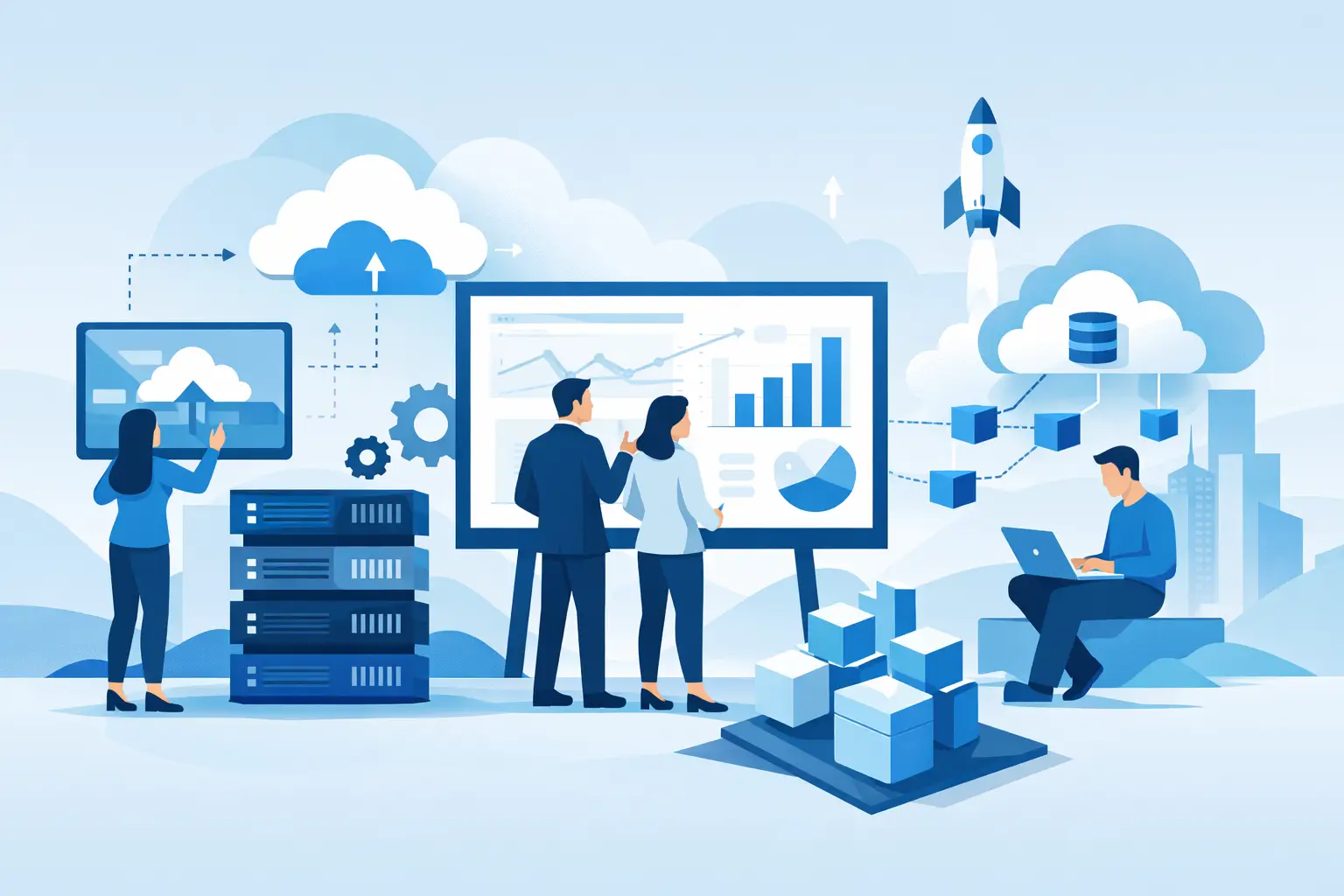
Effective enterprise modernization services connect five disciplines that are too often managed separately: process improvement, data management and architecture, digitization, intelligent automation, and AI-enabled decision support. The value comes from their sequence and integration.
Process redesign establishes the target state. It identifies unnecessary handoffs, duplicate controls, policy gaps, avoidable approvals, and high-cost exceptions. Data work then creates common definitions, ownership, quality rules, and usable connections across the systems that support the process. Only then can automation be designed around stable rules and known exception paths.
AI and GenAI can add significant value, particularly in document-heavy and knowledge-intensive work. They can classify requests, extract and summarize information, assist agents, identify patterns, and recommend next actions. Yet their effectiveness depends on context, governed data, appropriate controls, and a clear human decision model. An AI assistant trained against poorly organized content will make weak recommendations faster. For regulated or high-impact decisions, human review and traceability remain essential.
Finally, dashboards and measurement systems make performance visible. Leaders need more than a count of bots deployed or documents processed. They need to see cycle time, first-pass yield, touchless processing rate, exception causes, backlog aging, cost per transaction, service-level adherence, and the business impact of process changes.
A single integrated model also reduces vendor fragmentation. When separate providers own strategy, data, process design, automation, and support, problems at the boundaries are predictable. One team may blame source data, another may blame workflow design, and a third may be responsible only for the bot. A unified delivery partner can manage the full chain from diagnosis to implementation and ongoing optimization.
A disciplined path from process pain to performance
Modernization works best as a structured execution program, not a collection of disconnected innovation initiatives. The right pace depends on business urgency, technical debt, and the availability of process owners. Still, the progression should be clear.
1. Establish the baseline and prioritize the work
Begin with the operational facts. Map the end-to-end process, including the real variations that occur outside formal documentation. Measure volumes, handling times, rework, exception rates, wait states, systems touched, and control points. Process mining can help where event data is available, but interviews and frontline observation remain necessary when data does not capture manual work.
Prioritization should balance value and feasibility. High-volume, repeatable work with clear rules can be a strong automation candidate. A fragmented but strategically important process may require redesign and data remediation before any automation is appropriate. The portfolio should include near-term improvements that build confidence and foundational work that enables scale.
2. Design the target process before selecting the solution
A future-state design should make decisions explicit. What triggers the process? Which data is authoritative? Which steps can be eliminated? When does work move straight through, and when must it be reviewed? Who owns exceptions? What evidence is required for audit and compliance?
This stage is where organizations prevent the common mistake of digitizing inefficient work. If three teams validate the same field because nobody trusts upstream data, simply accelerating all three validations does not improve the design. The better answer may be a single data-quality control at the source, supported by clear ownership and monitoring.
3. Build the data and integration foundation
Clean data does not mean every data issue must be solved before modernization begins. It means the information needed for a prioritized process is defined, accessible, monitored, and governed to the level required for reliable execution.
That may involve standardizing customer or supplier records, establishing a canonical data model, integrating ERP and CRM data, defining data quality thresholds, or creating an event layer for real-time process visibility. The architecture should fit the organization’s landscape and risk profile. A full platform replacement is sometimes justified, but often a targeted integration and data-management strategy delivers faster value with less disruption.
4. Automate, augment, and control at scale
With the process and data foundation in place, teams can choose the right execution technology. Workflow platforms are useful for orchestration and approvals. Intelligent document processing supports unstructured inputs. Robotic process automation can bridge legacy interfaces where APIs are unavailable. AI can classify, summarize, retrieve knowledge, and support judgment-based work.
The best design is rarely the one with the most advanced technology. It is the one that manages exceptions effectively, provides clear audit trails, supports security requirements, and can be operated without a specialized rescue team. Automation should be monitored like any other production capability, with ownership, service levels, change management, and failure handling.
5. Measure outcomes and improve continuously
Modernization is not complete at go-live. Performance data should reveal whether the target operating model is delivering the intended outcome and where process drift is occurring. If touchless processing falls, leaders should see whether the cause is data quality, a policy change, supplier behavior, or a system integration issue.
This feedback loop turns modernization into an operating discipline. It also creates better investment decisions. Instead of funding technology based on broad promises, leaders can expand initiatives that demonstrate lower cost per transaction, improved service levels, stronger control performance, or shorter cycle times.
What leaders should demand from a modernization partner
The partner selection decision should not center only on platform certifications or a catalog of automation tools. Those matter, but they do not prove an ability to change enterprise performance. Leaders should look for a team that can work across business operations and technology, challenge inefficient process assumptions, and remain accountable after implementation.
Ask how the partner identifies and quantifies value before proposing a solution. Ask how data quality, governance, cybersecurity, and change adoption are handled. Ask who supports the environment once workflows, automations, and AI capabilities are in production. Most importantly, ask for evidence that the provider can move from a local use case to a governed, reusable enterprise capability.
Ective approaches this work as a connected transformation program: organize workflows, structure and connect data, automate the right work, and create real-time visibility into performance. That approach is designed to reduce the gap between a promising pilot and a dependable operating model.
The trade-off leaders need to manage
There is always pressure to move quickly. In some cases, a contained automation can deliver immediate relief and should not wait for a broad transformation roadmap. But speed without design creates debt, especially when a short-term solution becomes business-critical.
The practical answer is not choosing between quick wins and foundations. It is delivering quick wins that conform to an agreed architecture, process standard, and measurement model. Each initiative should leave the organization with cleaner data, clearer ownership, reusable components, or stronger visibility than it had before.
The organizations that gain the most from modernization do not treat it as a technology purchase. They treat it as a measurable redesign of how the enterprise runs. Start with the process that creates the most friction, establish the facts, and build from there with the discipline required to scale.