A finance team closes the month with 14 spreadsheets, three approval inboxes, and a queue of exceptions that only two experienced employees can resolve. An RPA bot can copy data between systems, but it cannot fix unclear approval rules, reconcile conflicting master data, or explain why an exception occurred. Enterprise hyperautomation addresses the full operating problem, not just the manual click.
For operations-heavy organizations, that distinction determines whether automation becomes a scalable capability or another collection of point solutions. The goal is not to automate every task. It is to redesign high-value workflows, establish reliable data, connect the right technologies, and create visibility into performance from end to end.
Why isolated automation programs stall
Many organizations begin with a reasonable objective: reduce repetitive work in finance, customer service, procurement, supply chain, or shared services. They deploy a bot to process invoices, extract information from documents, or move records between enterprise systems. Early results can be positive, especially where volume is high and rules are stable.
The difficulty appears when the program expands. Each automation inherits process variations, local workarounds, inconsistent source data, security constraints, and exceptions that were never formally designed. Maintenance effort grows. Teams struggle to identify who owns the process, the data, and the automation. Leaders see individual productivity gains but lack a clear view of overall business impact.
This is not primarily a technology failure. It is an execution model failure. A bot operating on top of a broken process may accelerate work, but it can also accelerate errors and conceal the underlying cause. Similarly, adding AI to unstructured documents does not solve a workflow with vague decisions, missing controls, or disconnected systems.
Enterprise hyperautomation treats these dependencies as one transformation agenda. It combines process improvement, data management, integration, intelligent automation, AI, and performance measurement to improve how work actually moves through the organization.
What enterprise hyperautomation includes
Hyperautomation is often described as the coordinated use of automation technologies. That definition is accurate but incomplete for an enterprise context. Technology is only one layer. A durable program also needs operating discipline around process design, governance, data, and adoption.
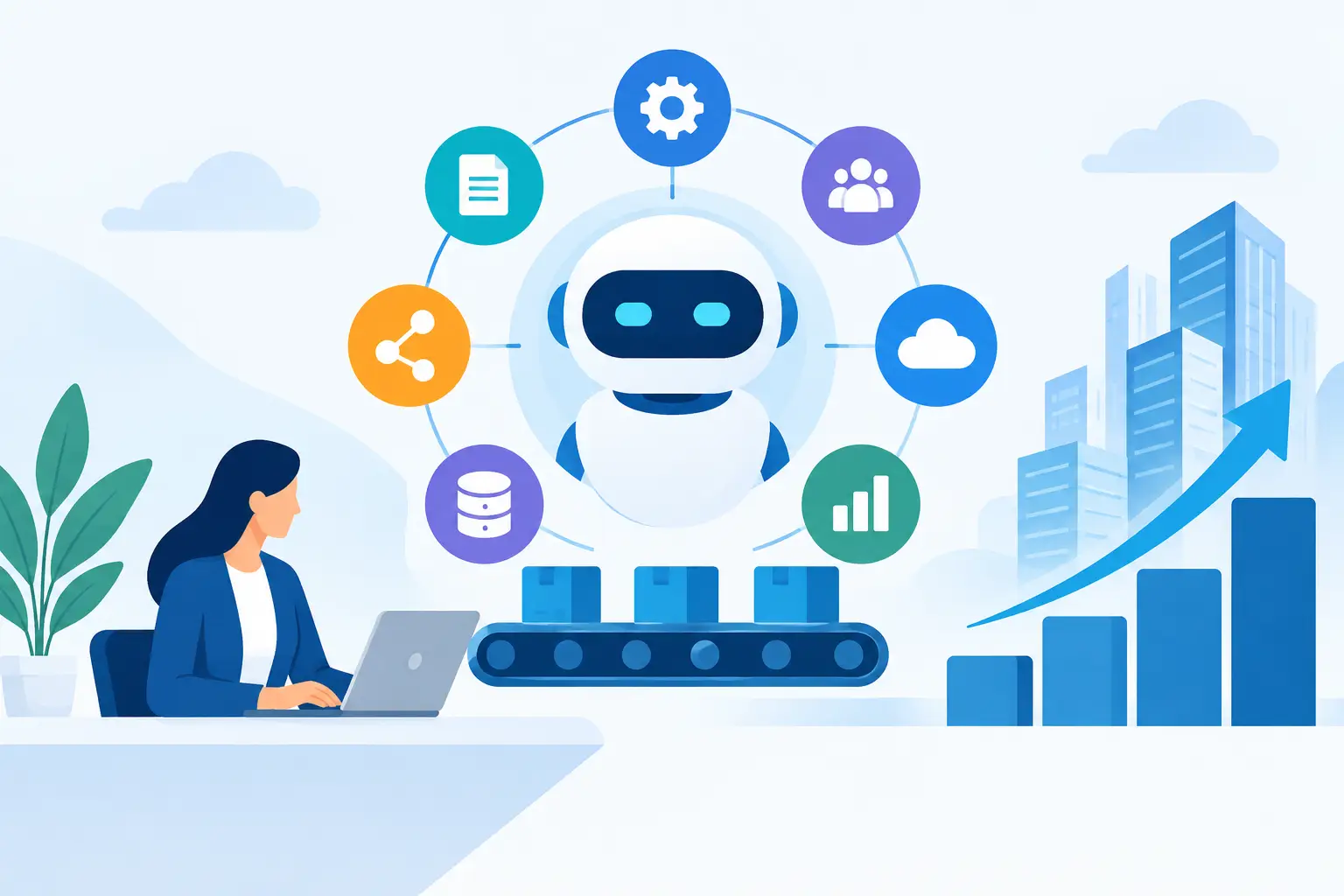
At its core, the model connects five capabilities. Process intelligence identifies how work flows in reality, where delays occur, and which variants create cost or risk. Process redesign removes unnecessary handoffs, standardizes decisions, and defines exception paths before automation is built.
Data architecture then establishes the data required for reliable execution. This can include master data standards, validation rules, document structures, ownership models, and integrations between core platforms. Without this foundation, automated workflows are forced to compensate for bad inputs through increasingly complex logic.
The automation layer may combine workflow orchestration, robotic process automation, APIs, document intelligence, rules engines, and low-code applications. AI and GenAI can support classification, extraction, summarization, agent assistance, and decision support where language or variable content is involved. Finally, dashboards and measurement systems make throughput, exception rates, cycle time, compliance, and capacity visible to process owners.
The mix depends on the process. A stable, rules-based task may need an API integration rather than RPA. A high-volume document process may benefit from AI extraction plus human validation. A complex approval flow may require workflow orchestration and policy redesign before any automation is considered. The right answer is based on business value and operational fit, not on using the newest tool.
Start with the process, not the platform
The most effective enterprise hyperautomation programs begin by selecting processes with a clear business case. High transaction volume matters, but volume alone is not enough. Leaders should assess the cost of delay, error exposure, customer impact, regulatory requirements, process variability, data quality, and the degree to which a workflow crosses departments or systems.
A practical assessment separates demand from feasibility. Invoice processing may offer a strong opportunity because it is repetitive and measurable, but only after supplier data, purchase-order matching rules, and exception ownership are understood. Order management may have a larger commercial impact, yet require more careful sequencing because it touches inventory, pricing, credit, and customer commitments.
This work produces a prioritized portfolio rather than a long list of automation ideas. The portfolio should identify quick wins that build momentum, foundational initiatives that address common data or integration constraints, and strategic workflows where redesign can change service levels or operating costs materially.
Process owners must be involved from the start. IT can provide architecture, security, and integration expertise, but it cannot define the operational decisions that make a workflow effective. Conversely, business teams cannot scale automation without technical standards and managed delivery. Enterprise programs work when ownership is shared and decisions are made against measurable outcomes.
Design for exceptions and accountability
Straight-through processing is valuable, but exceptions are where many automation projects lose control. A mature workflow does not simply route every exception to a generic queue. It categorizes the reason, assigns clear ownership, sets service targets, captures the resolution, and feeds recurring issues back into process improvement.
For example, an automated accounts payable process should distinguish between missing purchase orders, duplicate invoices, tax discrepancies, and supplier master-data issues. Each requires a different action and may belong to a different team. Treating them as one manual queue makes performance harder to manage and obscures the fixes needed upstream.
This is also where governance becomes practical. Controls for access, approvals, audit trails, model behavior, and human intervention should be built into the workflow design. In regulated or high-risk processes, human judgment may remain essential. The objective is not full autonomy at any cost. It is faster, more consistent execution with appropriate oversight.
Build an architecture that supports scale
Enterprises rarely begin with a blank slate. Most operate a mix of ERP, CRM, legacy applications, data platforms, collaboration tools, and departmental solutions. Hyperautomation must work within that environment while reducing future complexity.
A scalable architecture favors reusable components over one-off scripts. Standard connectors, shared document models, common identity controls, centralized monitoring, and reusable workflow patterns lower the cost of the next use case. Where direct APIs are available and governed, they are generally more stable than screen-based automation. RPA remains useful when legacy interfaces cannot be changed, but it should not become the default integration strategy.
Central standards do not require every process to be identical. Business units may have legitimate regulatory, market, or customer-specific differences. The discipline is to distinguish necessary variation from accumulated local habit. Standardize the common core, manage approved variants explicitly, and avoid allowing every team to build its own automation stack.
Data deserves the same attention as the automation platform. If customer, product, supplier, or asset data differs across systems, automation can create faster inconsistencies. Data ownership, quality thresholds, lineage, and remediation processes are not side projects. They are conditions for reliable automation at scale.
Use AI where it improves the decision path
AI expands what organizations can automate, particularly in document-heavy and knowledge-intensive workflows. It can classify incoming requests, extract data from variable formats, summarize case histories, recommend next actions, and help employees find relevant policy information. GenAI can also improve the usability of automation by turning structured operational knowledge into more accessible assistance.
Yet AI should be deployed with clear boundaries. A model that drafts a customer response may be appropriate with review controls. A model that determines payment eligibility, clinical action, or compliance disposition demands a stronger validation framework, explainability, monitoring, and human accountability. Accuracy rates alone are not sufficient. Organizations must understand the cost of a wrong answer and design controls accordingly.
The best use cases place AI within a defined workflow. Inputs are governed, outputs are checked, decisions are logged, and exceptions follow an explicit route. This turns AI from an isolated experiment into an operational capability that can be measured and improved.
Measure outcomes, not bot counts
A program that reports the number of bots deployed is measuring activity, not value. Enterprise leaders need metrics that connect automation to business performance. Depending on the process, these may include cycle time, first-time-right rate, cost per transaction, straight-through processing rate, backlog age, exception volume, working capital impact, compliance adherence, and customer response time.
Baselines matter. Without a credible before-state, even a successful implementation can struggle to prove its contribution. Measurement should continue after go-live because volumes change, process variants emerge, and new exceptions expose improvement opportunities.
A useful operating cadence brings process owners, IT, data teams, and automation specialists together to review performance, resolve blockers, and prioritize the next improvements. This is how organizations move from disconnected projects to a managed automation portfolio.
Ective approaches this work as an integrated delivery challenge: simplify the workflow, organize the data, connect the architecture, automate the right decisions, and make performance visible. That sequence reduces maintenance burden while creating a stronger foundation for future AI adoption.
The most valuable next step is not to buy another automation tool. Choose one business-critical workflow, map how it operates today, quantify the friction, and identify what must change in the process and data before automation begins. That discipline creates results leaders can measure and teams can sustain.